Defining the Profile of Spiritual Leadership in the Gospel of John
November 10, 2025
Synthesis of the Adaptive Leadership Model
February 24, 2026
The failure of the known
The ancient city of Athens was paralysed by a relentless plague, at the beginning of the 6th century BC. Having exhausted every known medical and religious remedy, the city’s great men realised their known models of leading had failed. In desperation, they sent for Epimenides of Crete.
A figure so respected1 that he was sought after by the lawgiver Solon and the philosopher Pythagoras, Epimenides was more than a poet and a wise man; Plato later described him in the Laws2 as a theion andra — “a divine man” or “an inspired man”. As expected, his approach to the crisis was intriguing as it defied conventional wisdom. Epimenides knew the city’s plethora of altars and temples and understood the paradox: despite their religious devotion, the Athenians were trapped by what they knew. And no known god could help.
His suggestion was not to introduce a new named deity, but to appease the one they had overlooked, that “missing piece” in their otherwise self-sufficient worldview. He nudged them toward the humility of acknowledging the obvious presence of an unknown power. This concept wasn’t necessarily unique; in Mesopotamia, petitioners would offer a “Prayer to Any God,”3 (not to every god) specifically addressing the singular, unnamed and unknown deity with whom they sought to reckon.
An altar to an unknown god
The story is told in the 3rd century AD by Diogenes Laertius in Lives of Eminent Philosophers.4 Addressing this known unknown, Epimenides
took sheep, some black and others white, and brought them to the Areopagus; and there he let them go whither they pleased, instructing those who followed them to mark the spot where each sheep lay down and offer a sacrifice to the local [appropriate] divinity. And thus, it is said, the plague was stayed. Hence even to this day altars may be found in different parts of Attica with no name inscribed upon them, which are memorials of this atonement.

The crisis was averted, yet the reality was far from perfect. The great statesman Solon, despite his legendary wisdom, confessed5 to Epimenides:
It seems that after all I was not to confer much benefit on Athenians by my laws, any more than you by purifying the city. For religion and legislation are not sufficient in themselves to benefit cities; it can only be done by those who lead the multitude in any direction they choose. And so, if things are going well, religion and legislation are beneficial; if not, they are of no avail.
Solon’s realisation is a testimony that systems and rules, methodologies and rituals are merely tools. And thus, by nature, static and limited. They only function when a leader accounts for the “missing variable”, an elusive and yet key element.
Aristotle6 highlighted a distinctive quality in Epimenides’ insight, noting that he “did not practice divination about the future, but only about the obscurities of the past.” Even this case, as it seems, shows that his leadership was not based on miraculous forecasting, but on diagnosing the hidden roots of a crisis in order to move forward.
The anonymous altar revived
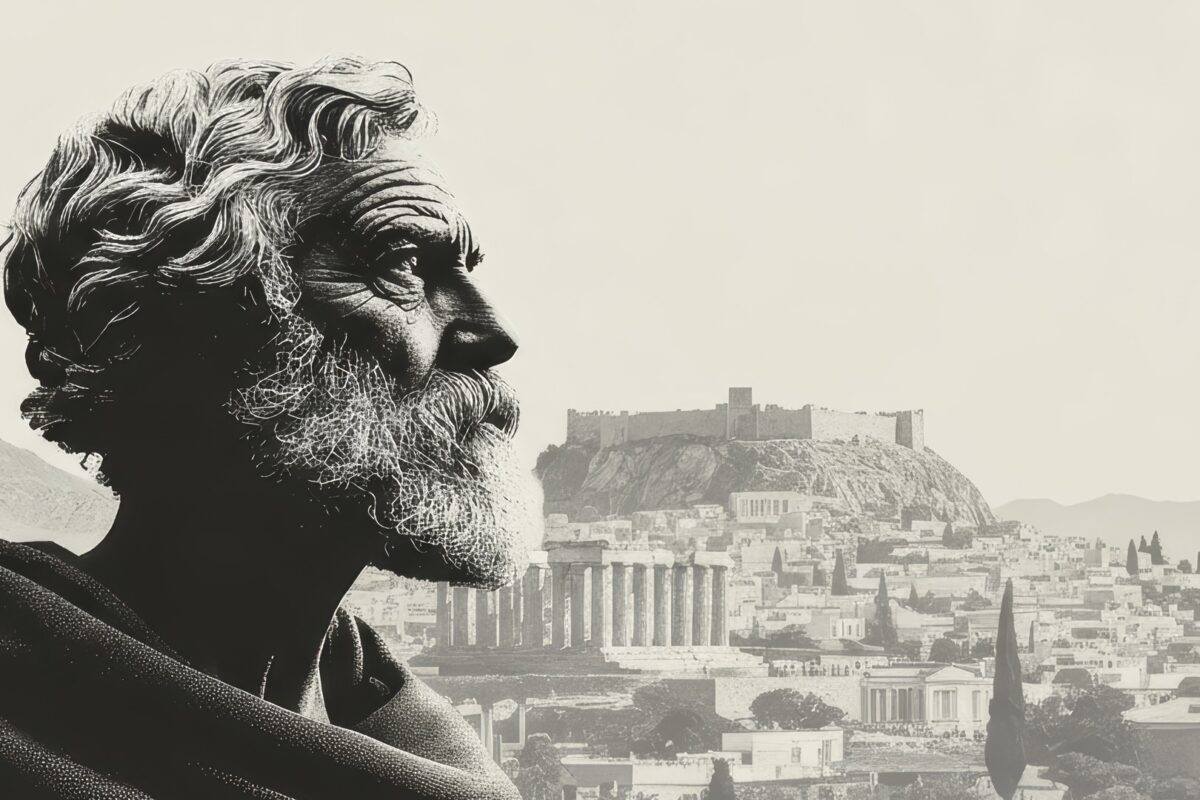
Such legacy of seeking the unknown endured for centuries. Hundreds of years later, the Apostle Paul stood on that same Areopagus and drew upon this very legacy of Epimenides. Addressing an august audience of Stoic and Epicurean philosophers, he pointed to one of those anonymous altars and revived its meaning.
Quoting the poetry7 of Epimenides himself about the supreme deity — “In him we live and move and have our being” — Paul boldly proclaimed that the “unknown god” (agnostos theos) they had honoured for generations was the very truth he was there to proclaim. The leadership of Solon and Epimenides might have found its missing link.
Leadership and modern pestilence
Fast forward to our days, by the dawn of the new millennium, the study of leadership had reached a saturation point: researchers had identified 66 distinct types8 of leadership and offered over 1,500 different definitions9 of what leadership is. Yet, despite this mountain of data, our modern world remains in a state of “pestilence.” Leaders are faltering, followers are disillusioned, legislations are stacked and our conventional wisdom is constantly reaching its limits.
Perhaps, like the Athenians of the past, we are looking at the many altars — monuments to every leadership theory — while missing the vital connection that makes any of them work.
Reclaiming the spirit of leadership
This connection is not a new invention; for over three decades, a robust framework has existed in the quiet corners of academia and practice. It may sound like an “unknown model of leadership” only because it has been overlooked in favour of more mechanical and popular approaches.
Spiritual leadership is not a new set of rules, metrics, or rituals. It is a return to the “heart” of the human connection to a higher power and to fellow humans — an alignment that is both vertical and horizontal to the betterment of community.
References:
- https://www.britannica.com/biography/Epimenides
- Plato, Laws, from Plato in Twelve Volumes, Vols. 10 & 11 translated by Robert Gregg Bury (1869-1951). Cambridge, MA, Harvard University Press; London, William Heinemann Ltd.
- Reading Akkadian Prayers and Hymns, An Introduction, 2011, p. 447. https://www.sbl-site.org/wp-content/uploads/2025/01/9781589835962_OA.pdf
- Diogenes Laertius. Lives of Eminent Philosophers, Volume I: Books 1-5. Translated by R. D. Hicks. Loeb Classical Library 184. Cambridge, MA: Harvard University Press, 1925, p. 115.
- Diogenes Laertius. Lives of Eminent Philosophers, https://topostext.org/work/221#1.64
- Artistotle, Rhetoric, Book 3, chapter 17, 1418a, https://kairos.technorhetoric.net/stasis/2017/honeycutt/aristotle/rhet3-17.html
- They fashioned a tomb for thee, O holy and high one — The Cretans, always liars, evil beasts, idle bellies! But thou art not dead: thou livest and abidest for ever, For in thee we live and move and have our being. See also “In him we live and move and have our being” (Acts 17:26).
- Akpa, E., Ajayi, A. I., Akpa, E. I., Kpakur, I., Adeleye, G. O., & Akerele, B. A. (2021). Leadership theories and the role of leadership in organizational development. International Journal of Research and Innovation in Social Science (IJRISS), 5(10), 1081-1087; Dinh, J. E., Lord, R. G., Gardner, W. L., Meuser, J. D., Liden, R. C., & Hu, J. (2014). Leadership theory and research in the new millennium: A meta-analysis and trend analysis. The Leadership Quarterly, 25(1), 36-62.
- Bennis, W. G. (1997). Organizing genius: The secrets of creative collaboration. Addison-Wesley; Dent, E. B., Higgins, M. E., & Wharff, D. M. (2005). Spirituality and leadership: An empirical review of definitions, distinctions, and embedded assumptions. The Leadership Quarterly, 16(5), 625-653; Mango, E. (2018). Leadership: Concepts and theories. GRIN Verlag; Rajni, K., Garg, N., & Jalan, S. (2025). Spiritual Leadership Research: Past, Present and Future Using Bibliometric Analysis. Journal of Religion and Health, 64(2), 999–1030.