

Synthesis of the Adaptive Leadership Model
February 24, 2026
One of the great benefits of seasoned leadership is knowing the path ahead. Because you’ve walked it before, you can guide others through what is for them unfamiliar terrain: a long trail, faded or missing marks, even a dark valley. You can lead with the quiet confidence that an amazing view waits on the other side of the peak.
Asking for a friend
During a recent conversation with a colleague, I recognised a few painful landmarks in the stories we shared: the wounds of a prolonged conflict, the sting of defeat, and the heavy cloud of isolation. It wasn’t utter despair, rather disappointment.
That talk sent me back to Robert Clinton’s classic, The Making of a Leader. After analysing the lives of 3,500 leaders, Clinton identified clear patterns in how God develops a person. One of interest for our discussion was the journey through difficult seasons. Never wasted by God, hardships are allowed, if not intentionally designed. We often interpret suffering as punishment, but what if it is divine preparation for something greater?
I browsed the pages considering these three, relevant to our discussion: conflict, losing, and isolation.
Conflict
Conflict is inevitable. When it hits, our instinct is to assume something has gone wrong (the fault being with others). We suspect bad motives. If we can, we avoid it at all costs. However, we could be tempted to fight, or to retreat in defeat. Clinton challenges us to see conflict as an essential element in leadership development:
“Conflict is a powerful tool in the hand of God and can be used to teach a leader lessons that he would not learn in any other way. God uses conflict, whether personal or ministry related, to develop the leader in dependence upon God, faith, and insights relating to personal life and ministry.”
Handled well, conflict produces maturity: “A leader experiencing leadership backlash learns through conflict with others to submit to God in a deeper way.”

None of us welcome such seasons. Surely one’s family does not want to hear of yet another conflict. But what if it is what Clinton calls “negative preparation”, meaning:
“God’s use of events, people, conflict, persecution, and experiences that focus on the negative, in order to free a person from the present situation to enter the next phase of development with revitalized interest.”
Make no mistake here, “the emphasis is not on escaping, but on release and on preparation to accept a new situation with an abandonment that would not otherwise be there.”
Even more challenging is when the clash involves authority.
“A developing leader will usually struggle with someone who is in authority over him.”
That hits close to home.
In some situations we yield. In others we stand. Clinton graciously reminds us “Learning submission is critical to learning what authority is, so emerging leaders must first learn to submit.”
But what if the leadership is genuinely in the wrong? That demands spiritual discernment:
“Conflict in ministry requires discernment skills. What is from God and what is not? Conflict can arise from different approaches to ministry as well as from personality clashes.”
Let’s pause here. Is God using authority to shape you? (Even imperfect leaders?) Is it a clash of principles, views, personality? Is God using you to make them a better leader?
Clinton offers a sobering conclusion:
“The most important relational insight I have learned is that subordinates must be very careful in their correction of those in authority over them. One needs to be more than just right on issues to correct such a leader.”

Losing
Even when you are right (and I suspect you think so), facing institutional power ends in loss. Yes, it is a bitter medicine. Clinton is blunt about the reality of hierarchy:
“In a power conflict, the leader with higher power will usually win regardless of rightness of issue.”
Regardless?
When you draw the bottom line it looks like a clean defeat. Yet human authority doesn’t operate outside of God’s sovereignty.
Isolation
What almost always follows such a loss is… isolation. (ABBA’s song said something like: “The winner takes it all / The loser standing small.”) And yet Clinton describes isolation as “one of the most effective means for maturing a leader.” That is clearly counterintuitive. For a time.
Most leaders focus on skills and features (the “having”) or on managerial tasks (the “doing”). But God wants us at times to move aside, and shift our focus to “being” (see Fry & Kriger, 2009). As in an inner transformation. And that takes place best in environments where action, plans, projects, sweat are no longer an option. Leaving room for quiet reflection, deep evaluation, perhaps spiritual renewal. “One way that God forces a leader into reflective evaluation and into a “being” stage of the upward development pattern involves isolation.”
“Several times in a leader’s lifetime, the leader may be set aside from his normal ministry. Causes may include crises, disciplinary action, providential circumstances (such as war, oppressive government action, illness), or self-choice. The thrust of the processing is on the recognition that the isolation is God’s work.”
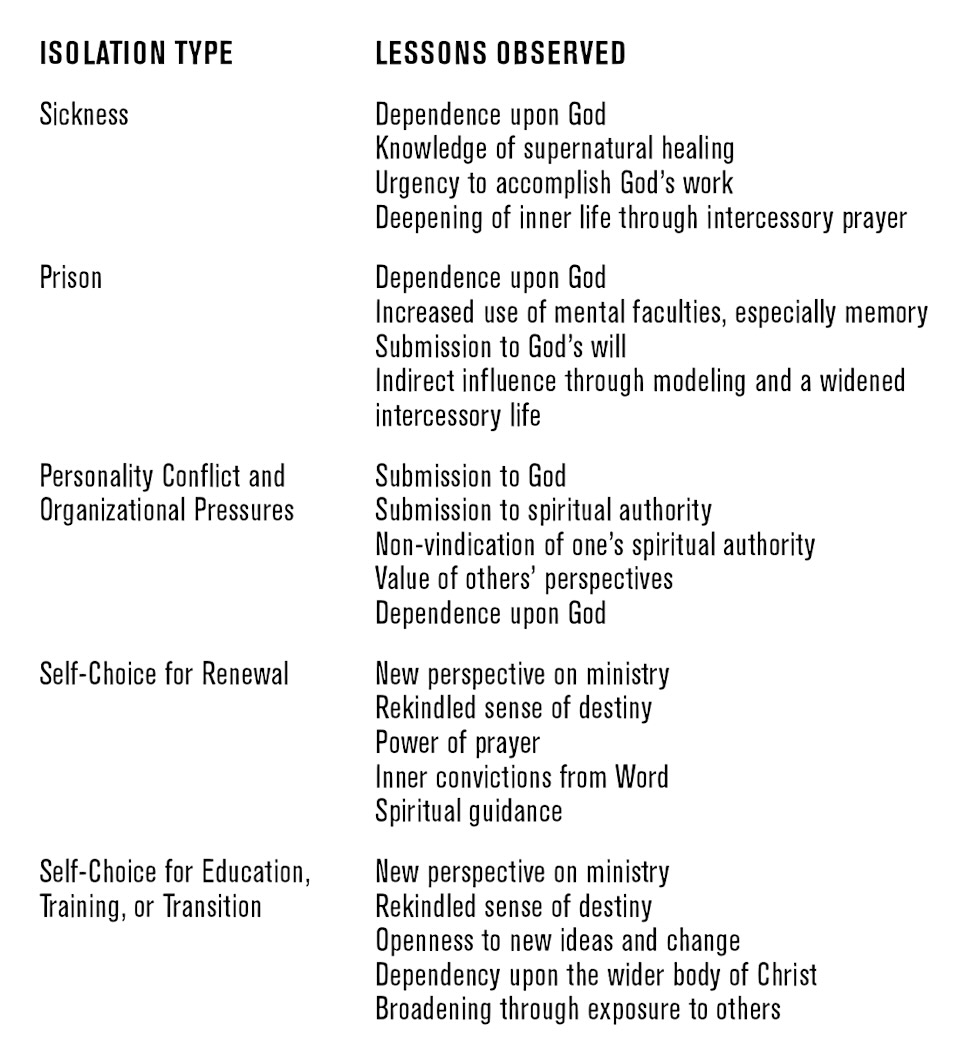
Isolation rarely comes with an immediate escape plan. The best posture is to let God do His work in you (not through you). When finished, you’ll be back. “Isolation is often used by God to teach important leadership lessons that could not be learned while experiencing the pressures of normal ministry context.”
Pulling it all together
Conflict will come. It is needed for growth in God’s glory. Apostle Paul affirmed it:
“No doubt there have to be differences among you to show which of you have God’s approval.” (1 Corinthians 11:19, NIV)
Fighting authority rarely ends in victory. Unless the other party is clearly disqualified, moral bankrupted, the one in lower position will bear the loss.
“Slaves, in reverent fear of God submit yourselves to your masters, not only to those who are good and considerate, but also to those who are harsh.” (1 Peter 2:18)
While seemingly unfair, trust God with the outcome. He holds the supreme authority.
And when in isolation, remember God. Think of Joseph in the Bible: every stage of his journey, from the pit, to being sold as a slave, then serving in Potiphar’s house, and then for years in prison, was necessary preparation for what lay ahead. Beyond the human failures, he could see a divine purpose:
“You intended to harm me, but God intended it for good” (Genesis 50:20).
Bibliography:
Clinton, J. R. (2012). The making of a leader: Recognizing the lessons and stages of leadership development. NavPress.
Fry, L. W., & Kriger, M. P. (2009). Towards a theory of being-centered leadership: Multiple levels of being as context for effective leadership. Journal of Organizational Change Management, 22(1), 60–78.